Sign In
The 7% Rule in Trading: A Guide to Smarter Risk Management
 Lukas Schmidt
How much should you risk on a single trade? This is one of the first questions new traders should ask themselves. A popular answer among experienced traders is the 7% rule.

In simple terms, this rule protects you from crippling losses and keeps you in the game for the long run. For example, if your account size is $10,000, 7% of that is $700. According to the 7% rule, $700 is the maximum you should be willing to lose on a single trade, no matter how promising the opportunity might seem.
Why bother with risk control instead of just chasing quick wins? Simple – one big loss can ruin months of progress.
Drop your account by 20–30% in a single trade and it feels like getting punched in the gut; climbing back from that is brutal. Keeping losses capped at 7% means no single screw-up takes you out of the game. It forces discipline too. You cut losers before they snowball into disasters. On StockInvest.us, we actually try to make this easier: every stock we analyze comes with a risk rating (from Very Low to Very High) and a suggested stop-loss level.
Think of it as a shortcut for spotting how volatile a stock really is and where you might draw the line, so sticking to something like the 7% rule feels a lot less guesswork and a lot more doable.
Why traders use the 7% rule?
The 7% rule has become popular for several important reasons:
- Capital Preservation: The first rule of trading is simple – stay in the game. Risking only a small slice of your account keeps you alive through losing streaks. Even a string of 7% losses stings, but it won’t knock you out. You still have room to recover when the market turns.
- Discipline: A hard cap like 7% forces you to cut losers fast. It overrides emotions, no more holding a bad trade because you “just need a little more room.” That habit often ends with bigger losses.
- Consistency: Using the same risk percentage every time keeps your results steady. No single trade runs your account – wins and losses stay balanced. This makes it easier to see if your overall strategy really works.
- Proven Strategies: Legendary investor William O’Neil cut all stock losses around 7–8%. His research showed strong companies rarely drop more than that from a good entry. If they do, it’s a red flag. Following the same rule protects you from one blow-up trade ending your journey.
In short, traders use the 7% rule because it provides a safety net.
It’s not about avoiding losses completely (losses are inevitable in trading), but about making sure your losses are small and manageable. This way, your account can handle the ups and downs of the market, and you maintain the psychological confidence to keep trading wisely.
How to apply the 7% rule in practice
Knowing the theory of the 7% rule is one thing. Now let’s translate it into practical steps for your trades. Here’s a step-by-step breakdown:
STEP 1:
Determine Your Account Size
First, note the total capital in your trading account. For example, let’s say you have $10,000 in trading funds. Calculate 7% of your capital: on a $10,000 account, 7% is $700. This $700 is the maximum you are allowed to lose on the next trade. Think of it as your personal loss limit for that trade.
STEP 2:
Set a Stop-Loss Level Based on Analysis
Before entering a trade, identify a logical exit point (stop-loss) on the chart where you’ll cut your losses. This should be based on technical analysis, for instance, a support level slightly below your entry price, a moving average line, or a percentage drop that wouldn’t normally occur unless the stock’s trend is reversing.
The idea is to place the stop where, if the price hits it, it signals that the trade setup likely failed.
STEP 3:
Adjust Your Position Size
Once you know your stop-loss price, calculate how many shares (or contracts, etc.) to trade so that if the stop-loss is hit, your loss ≈ 7% of your account. This position sizing step is crucial. Here’s how to do it:
- Determine the dollar difference between your entry price and stop-loss price (this is the risk per share).
- Divide your 7% risk amount (from step 2) by that per-share risk to get the number of shares.
Example: Suppose you plan to buy a stock at $50 per share, and based on the chart you set a stop-loss at $46.50.
The risk per share is $50 – $46.50 = $3.50. With a $700 max loss, you can buy up to $700 / $3.50 = 200 shares. If you bought 200 shares at $50, that’s a $10,000 position, and if the stock falls to $46.50, you’ll exit with about a $700 loss, or 7% of your account.
By following these steps, you are obeying the 7% rule: no single trade will lose more than $700 in this scenario.
You can, of course, trade a smaller position too, risking less than 7% is never a bad thing if you want to be extra safe. The key is never to exceed that $700 risk on any trade.
BONUS STEP:
Using StockInvest.us Stop-Loss Guidance
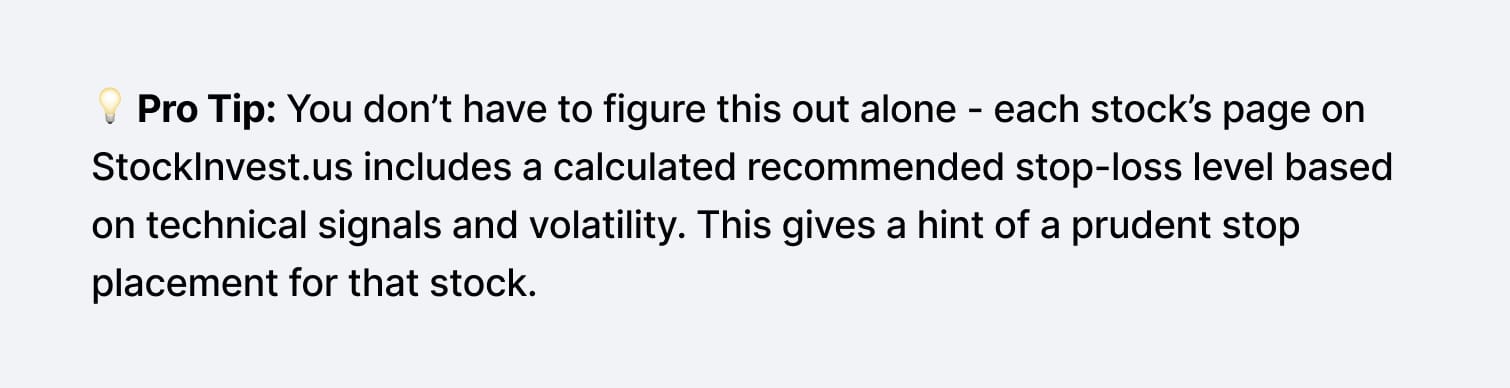
One useful feature of StockInvest.us is that for each stock we analyze, we provide a risk level and a suggested stop-loss price in the commentary.

For example, if a stock is labeled “Low Risk”, it typically has relatively small daily movements. Our analysis might say something like: “Our recommended stop-loss is $46.50 (-5%)” for a given stock, indicating that a 5% drop from the current price is a prudent cut-off. You can use this as a starting point to set your own stop.
Always cross-check that the suggested stop-loss would result in a loss no larger than 7% of your account based on how much you invest. If it would be larger, reduce your position size accordingly.
Using stock screener to support the 7% rule:
Finding the right stocks is a big part of safely applying the 7% rule.
Ideally, you want trade candidates that are stable, liquid, and in an uptrend, so that the probability of hitting your stop-loss is lower (or if it is hit, it’s because the trade truly failed, not just random volatility).
This is where the stock screener becomes extremely useful.
Let's take our StockInvest.us stock screener as an example. You can filter the entire market to pinpoint stocks that fit a conservative trading approach. Here’s how to leverage the screener for a 7%-rule-friendly strategy:
| Filter | Description |
|---|---|
| Risk Filter – Low | Shows stocks with lower volatility and steadier moves. Easier to use tighter stop-losses while staying under the 7% cap. |
| Trend Indicators – MA Cross, Bollinger Bands | Add signals like “21/100 MA Cross = Buy” or Bollinger breakouts to find stocks in uptrends. This tilts the odds in your favor. |
| Liquidity Filter – High | Focus on highly traded stocks. They’re easier to enter and exit, stops trigger more reliably, and price action is usually more stable. |
| Momentum – Positive Change | Look for stocks already moving up (e.g., up in the past week or month). Moderate momentum suggests strength, but avoid overextended names. |
Now, let’s put it all together in an example workflow:
Example Screener Setup:
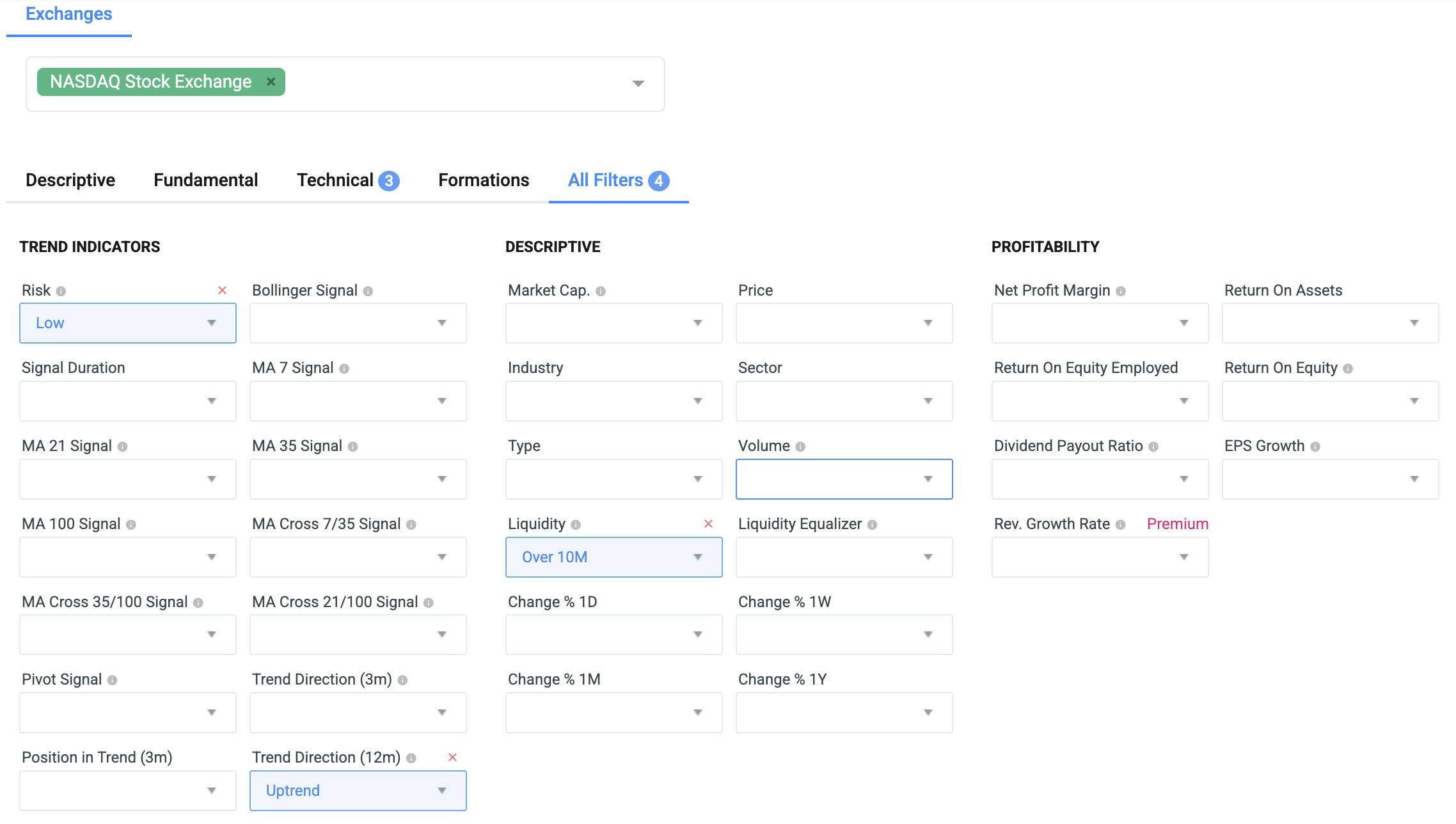
Say you want to look for safer trades in U.S. markets. In the StockInvest.us screener, choose NASDAQ + NYSE.
Then set:
Risk = Low (steady stocks, less volatility)
Liquidity = Minimum over 100M (easy to buy and sell)
Golden Cross 21/100 = Buy (21-day MA crossing above 100-day, a bullish signal)
This mix gives you stocks that are safer, actively traded, and showing an uptrend – a solid starting list.
At this point, you would see a list of stocks meeting the criteria:
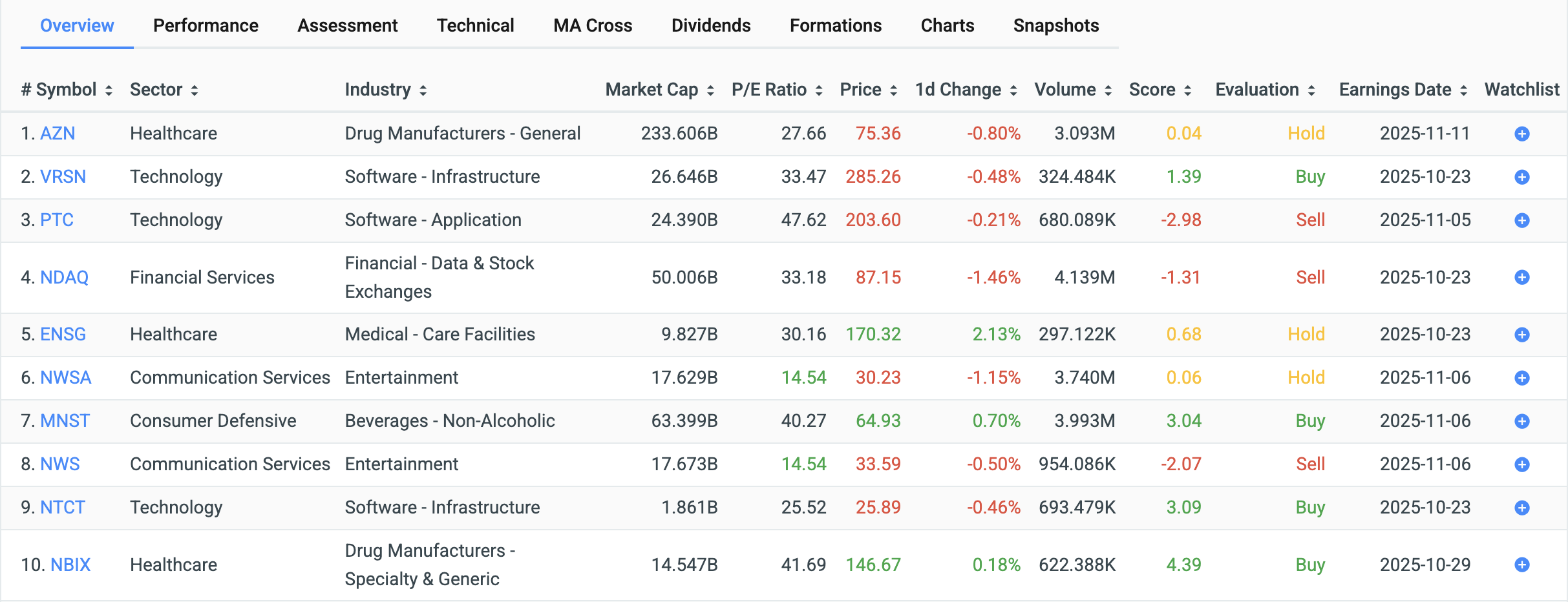
This screening approach yields candidates where applying the 7% rule is both safer and more practical.
For example, JNJ Example. Johnson & Johnson often shows “Very Low Risk” in analysis. It moves only 1–2% per day, is highly liquid, and can trigger buy signals like MA crossovers. A stop-loss about 3–5% below entry often works within the 7% rule.
So think about your trade plan. If JNJ trades at $176, you might set a stop near $170 (3–4% lower). That’s under the 7% cap, which is fine - the rule is a ceiling, not a target. For stocks needing more room, adjust your position size so losses still max out at 7%.
Why use the screener for safer picks? The screener filters out wild movers and highlights stable, trending stocks. This makes your 7% buffer more reliable and helps avoid random market noise knocking you out.
5 common mistakes to avoid:
When implementing the 7% rule (or any risk management plan), traders should be careful to avoid these common pitfalls:
| Mistake | Description |
|---|---|
| Risking More Than 7% “Because It Feels Safe” | Getting overconfident in a “safe” stock and risking more than 7% is dangerous – any stock can drop fast. The 7% rule keeps you disciplined. Stick to it every time. |
| Ignoring Liquidity | Low-volume stocks can skip over your stop, leading to bigger losses. Trade liquid stocks with tighter spreads, or use smaller risk. |
| Not Updating Risk | 7% changes as your account grows or shrinks. $10k account = $700 risk; $15k = $1,050; $8k = $560. Always recalc to match your balance. |
| No Exit Plan | Don’t just set profit goals – set stops too. Without a stop, small losses can turn huge. Plan your exit before entering the trade. |
| Moving Stops or Adding to Losers | Shifting stops lower or adding to a losing trade breaks the rule and kills discipline. Take the loss, reset, and protect your account. |
By being aware of these pitfalls, you can ensure that the 7% rule actually works for you as intended.
Remember, the consistency of applying the rule is what makes it effective. One big mistake can negate the benefit of many properly managed trades. So avoid these mistakes and you’ll reap the rewards of a solid risk management approach.
Conclusion
The 7% rule is about discipline and consistency. By capping losses, you protect both your money and your mindset, so one bad trade doesn’t wipe you out. Some traders even risk less 2% or 5%, but the key is always knowing your exit and never risking more than you can handle.
StockInvest.us makes this easier with risk ratings, stop-loss suggestions, and screener filters for risk, trend, and liquidity. These tools help you trade with a plan instead of gambling. Check it out >>
In the end, trading success isn’t about chasing huge wins, it’s about avoiding big losses and letting steady gains add up. Protect your capital today so you can trade again tomorrow.
About The Author
Lukas Schmidt